One of the negative impacts of the advertising tax has been that merchants have chosen to kick affiliates out of their affiliate programs to avoid charging sales tax to consumers.
The assumption here is that people shopping online are less likely to make a purchase if they have to pay tax.
But when I asked “When you shop online, are you less likely to buy if you have to pay sales tax?“, 73% of 237 respondents answered “no”.
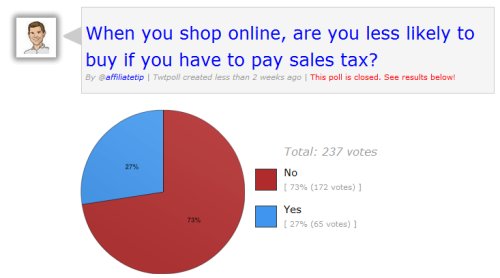
See the results at http://twtpoll.com/r/kbr87j.

{ 11 comments }
Your Message@Shawn Collins:
I agree. It is an unfortunate and common convention for folks, even large news outlets, to over-generalize and overstate unscientific poll findings when crafting headlines. That doesn’t make it right.
I’m not suggesting that you are intentionally misleading people. Rather, that you are seen as somewhat of a spokesman for the industry. I would hope that you are mindful in how you word headlines so that the politicians that are looking for excuses to justify their new taxation schemes don’t have false ammunition spoon fed to them from within the Affiliate industry.
I think you underestimate (or is it overestimate) people like the Governor of NC. She actually smirked/laughed when telling a reporter that the whole Amazon tax issues was a joke, that Amazon would not stop selling to NC residents. She made it abundantly clear that she was ignorant on the issue, and had not explored the text that supported whatever headline had given her the impression that Amazon was threatening to pull all SALES from NC.
Maybe I am oversensitive after what we just went through fighting the affiliate tax in NC.
It is too bad I don’t drink. This would be a great opportunity for a Beer Summit so that we could hash out our different points of view. I’ve found that adding alcohol to a disagreement is usually a sure-fire way to make things better. :^)
@Jeff Cress:
The respondents were not just readers of my blog – the poll was reTweeted by a number of people.
The figures are qualified in the text of the post, and it is a common convention to summarize the findings of a poll in this fashion.
For instance, see http://www.cnn.com/2009/POLITICS/02/20/bipartisanship.poll/
CNN states that “Most favor bipartisanship; Democrats, not so much” based on a poll of 1,046 people. The sample number is at the end of the article, and I think it’s safe to assume that nobody thought they polled most adults in the country.
Whoa! Careful Shawn. Right or wrong, you are seen as an authority in this industry. What you write carries some weight.
So when you make a blanket statement of fact like “Most Online Shoppers Not Influenced by Sales Tax”, shouldn’t you either:
a) qualify it… as in “Most of the 237 Affiliate Tip readers that responded to my unscientific twitter poll self-report that they are Not Influenced by Sales Tax”..
b) or, have the actual data to support what you say? A twitter poll of 237 folks that are almost certainly NOT an accurate representative cross section of the majority of online shoppers certainly doesn’t represent “Most Online Shoppers”. You obviously didn’t poll Most shoppers on the internet, so you shouldn’t make it read like you did.
Maybe those little details don’t matter to some people, but omitting a few words here and there completely changes the literal meaning of your findings. Your standard Affiliate reader likely knows how to interpret your comments accurately. However, we’ve had ample recent evidence that the Governor of NC, for example, does NOT take the time to understand what she reads. I shudder to think what she would do with the blanket finding from your poll.
While I appreciate the spirit of what you were trying to do with this poll, authoritative statements from industry luminaries based on casually conducted “research” are just the kind of “data” that politicians look for when trying to justify actions that just don’t make sense. I would sure hope that you would try to avoid giving them such powerful headlines to use against us in the future… unless you have scientific data to back it up.
@Geno Prussakov:
Good point – service makes a big difference to me online and offline in purchases.
@Scott Demarko:
Thanks on the mention of the book – it’s focused on tips and resources to manage an affiliate program. It was written back in 2000, so there are areas that are outdated, but overall much is still relevant.
Back then, there was a lot less government interference to consider. The good old days.
@Scott Demarko:
If anything, I think it would be less of a pain point for merchants to have a federal flat tax for all states online.
It does present an opportunity for companies to offer a software solution to manage it – I am sure there are some on the market, but I’d imagine they’re not affordable for Mom & Pops.
Great poll, results, and conclusions, Shawn.
There’s another facet of it. When I was conducting the research for my “Online Shopping Through Consumers’ Eyes” (2008) book, I discovered that people generally don’t mind paying more if they are offered stellar service (so, a lot depends on the merchants themselves). I asked this question: “If you had two e-tailers to choose from: merchant 1 with lower prices but poor customer support (phone not answered, e-mails not returned), and merchant 2 with slightly (10%-20%) higher prices but excellent support, from which one would you purchase?” 88.89% of survey respondents answered Merchant 2.
Of course after saying all this I realize you must know all this, though I haven’t read your book yet, I think I will jump over and get a copy.. http://www.affiliatemanager.net/book.shtml
Is there a section on insane amounts of government regulation? Haha. Pretty cool site by the way Shawn.. Someone from the twitter world recommended it.
~Scott Demarko
opinionated media guy
Your Message@Shawn Collins:
I agree that on small purchases a dollar here and there isn’t going to be that much of a sway point, but the amount of extra red tape the government is now asking for business’s to fill out in order to not only take tax but also to properly account, and distribute it to the government agency’s requesting it IRS/etc., is the reason I doubt this will change soon. The websites in question are probably less worried about the tax impact itself as the amount of extra time, energy, and money they now have to put in to making sure they are properly accounting for tax dollars collected, and properly distributing them to the IRS and now they have to provide more reports on earnings people in those states make as well. Is dealing with affiliates in states requiring tons of extra paperwork, accounting rules, and the big one TRANSPARENCY worth it? Some of these online programs are very private and like to keep it that way.
There is a loophole to everything though… For a small amount of money if someone had a serious affiliate business going and was recently revoked because of location, they could in theory setup an address in a state where taxes aren’t being charged for internet affiliates.
Here’s some sites that do this:
http://www.earthclassmail.com/
http://www.usabox.com/
http://www.mailnetwork.com
Most affiliate programs don’t do a great job of confirming location, identity etc. They just take your soc, your address you enter and let it ride. With the mail forwarding service you could get your checks in the state that is not being taxed, and forwarded to wherever you are in the world. In theory. Of course I am not a tax agent, lawyer, or recommending anyone skirt the law so check with the proper experts before doing something you regret
@Scott:
I didn’t miss it – this was meant to address the consumer. And tax isn’t the only factor in a purchase decision.
I frequently buy electronics online, and always go with reputable companies, rather than the best price.
Not to mention return policies like the one at Zappos – http://www.zappos.com/c/self-service-return-instructions – that makes them more attractive than companies that don’t offer the same option.
Also, your logic is based on a big ticket sale. I shop almost exclusively online, and the only items I can think of that ever approach the cost in your example are computers.
That’s not something I typically buy more than once a year. Rather, my purchases are often under $100, where free shipping offsets sales tax.
See the “Top 15 Online Retail Categories Based on Average Order Size” (http://www.clickz.com/3496786) from Nielsen//NetRatings MegaView Online Retail, April 2005:
Product Category Average Order Size (US$)
Computer Hardware 584.47
Event & Movie Tickets 121.60
Automotive 119.23
Office Supplies 102.47
Consumer Electronics 99.12
Child/Baby Care 86.13
Sporting Goods & Outdoor Activities 74.15
Home & Garden 69.99
Shoes & Athletic Footwear 53.14
Flowers, Greetings, & Specialty Gifts 51.61
Computer Software 46.76
Jewelry & Watches 46.62
Health/Wellness/Beauty 45.94
Apparel & Accessories 44.68
Toys, Games & Hobbies 40.41
So, with the exception of computer hardware, the AOS is $121.60 or less.
Don’t get me wrong, I certainly don’t want to see more taxes – I want less taxes and less government.
I was hoping affiliate programs would re-consider booting affiliates in states that declare them to constitute a tax nexus.
As a sales guy for several major online sites you missed how this impacts the retailer itself. Most of the people who answered no are most likely savvy enough to know you can always ask for a better deal. As my example, company A charges sales tax and company B doesn’t then company A will have to discount their prices to compete with company B. This leaves less profit for company A. So in order to maintain profitability and higher margins it makes since to want to have as much wiggle room as possible and online, tax has been that loophole that offers an internet company an advantage over a local establishment. I routinely ask, why buy from your local store at price + tax when I can sell it to you at the same price with no tax and save you money.
Its basic logic…
$1,000 x 7% = $70 in tax or would you like to save $70 and get it for $1000 + $10 in shipping?
Do the people in your poll all have endless sums of money? I am trying to picture why 70% of the people you polled wouldn’t want a better deal if it was offered to them. Or does everyone you polled work for the government and realizing that we can never cover the deficit they are taking polls on the net to convince everyone that tax on everything is a great idea?!
Comments on this entry are closed.
{ 12 trackbacks }